

SUMMARY:
XTIVIA explores the complex reality of active-active PostgreSQL replication, evaluating modern tools such as EDB PGD and AWS pgactive to help organizations determine whether their high-availability requirements truly justify the added operational complexity.
- Active-active setups introduce significant technical challenges related to conflict management, data consistency, and latency across global regions, requiring careful planning.
- Current solution options include AWS pgactive for cloud-native needs, EDB Postgres Distributed for enterprise environments, and the open-source pgEdge.
- While multi-master replication is feasible, most applications can achieve sufficient reliability and lower maintenance costs through standard active-passive configurations with fast failover.
Database administrators should view active-active replication as a specialized architecture for mission-critical, global systems rather than a default standard for general PostgreSQL workloads.
Table of contents
Introduction
Active‑active (multi‑master) replication has been a long-standing request in the PostgreSQL ecosystem. As applications become more global and uptime expectations approach five nines (99.999% uptime), the question keeps coming back:
Q: Can PostgreSQL safely support multiple writable nodes at the same time?
The short answer: yes, but with caveats. The long answer is what this blog is about.
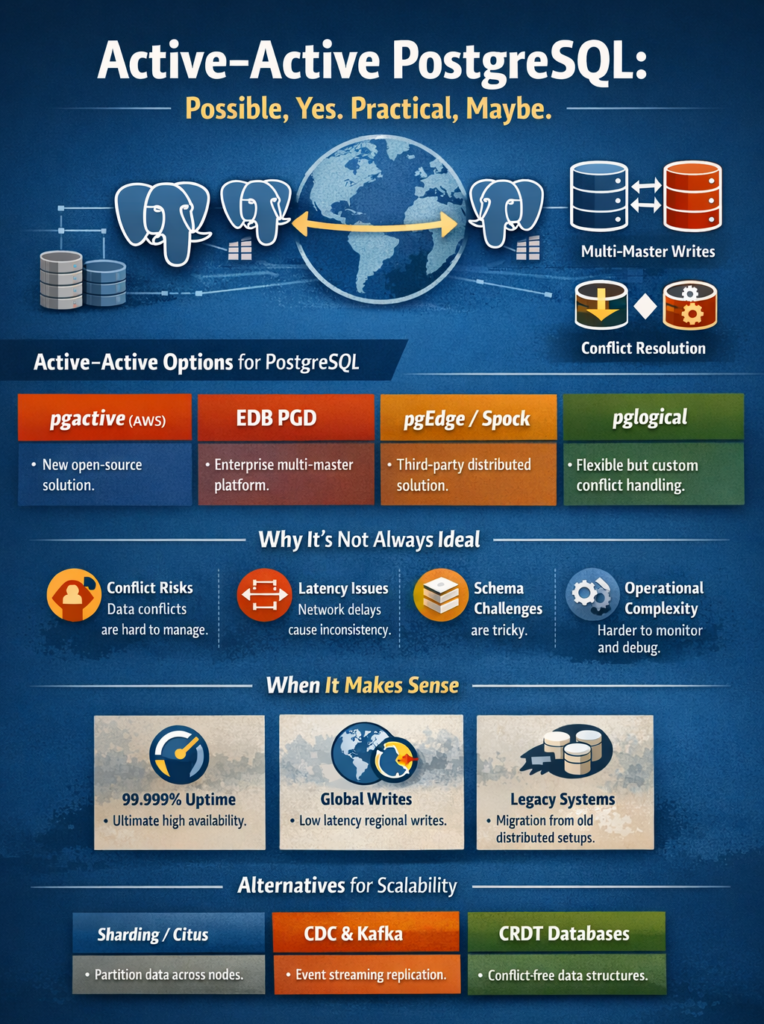
This article consolidates the latest options, real-world trade-offs, and expert recommendations around active-active PostgreSQL, including community, cloud-native, and enterprise offerings.
What “Active‑Active” Really Means
In an active-active setup, multiple PostgreSQL nodes accept writes simultaneously, and changes are replicated between them. This is fundamentally different from PostgreSQL’s native single-primary, multiple-standby model, where only one node can write, and others are read-only replicas.
PostgreSQL core does not natively support multi-master replication. All current solutions are built on top of logical replication, external extensions, or vendor platforms.
Why Active‑Active is Challenging in PostgreSQL
Before looking at solutions, it’s important to understand why this requires careful planning:
1. Conflict Management
Two nodes can update the same row simultaneously. Someone must decide:
- Which write wins?
- How conflicts are detected?
- Whether conflicts are resolved automatically or pushed to the application?
2. Consistency vs Latency
Active-active systems are usually asynchronous across regions. This means:
- Temporary inconsistencies are normal
- Strong consistency increases latency
- WAN links amplify replication considerations
3. Operational Complexity
Schema changes, sequence management, monitoring, debugging, and upgrades require more attention in multi-master systems.
This is why PostgreSQL’s default recommendation is still active-passive with fast failover.
The Current Active‑Active Options (2026)
1. AWS pgactive (Open Source)
pgactive is a recent option originally developed for Amazon RDS and is now open source.
Key characteristics:
- Asynchronous active-active replication
- Built on PostgreSQL logical replication
- Conflict detection and resolution (e.g., last-write-wins)
- Supports multiple writable nodes
- Designed with multi-region high availability in mind
Strengths:
- Modern and actively developed
- Backed by AWS engineering experience
- Open source
Considerations:
- Conflict resolution requires planning
- Schema changes require discipline
- Relatively new outside AWS environments
Best for: Teams needing multi-region write availability with eventual consistency.
2. EDB Postgres Distributed (PGD)
EDB PGD is an enterprise-grade active-active PostgreSQL solution built on BDR (Bi-Directional Replication) technology.
Key characteristics:
- Multi-master logical replication mesh
- Conflict management capabilities
- Cluster-aware tooling and monitoring
- Supports rolling upgrades and near-zero downtime maintenance
- Designed for global availability (high uptime targets)
Strengths:
- Proven in enterprise environments
- Rich operational tooling
- Commercial support available
Considerations:
- Proprietary platform
- Higher operational and licensing cost
- Built on logical replication semantics
Best for: Mission-critical systems requiring high availability and vendor support.
3. pgEdge Distributed PostgreSQL (Spock)
pgEdge uses the Spock logical replication extension for multi-master replication.
Key characteristics:
- Table-level replication control
- Conflict tracking and resolution
Strengths:
- Open-source core
- Flexible replication topology
- Designed for distributed PostgreSQL use cases
Considerations:
- Requires careful design to avoid conflicts
- Smaller ecosystem compared to some enterprise offerings
Best for: Teams wanting open-source multi-master PostgreSQL with control over replication.
4. pglogical / DIY Bi-Directional Replication
Logical replication extensions like pglogical can be used for bi-directional replication, but:
- Conflict handling is largely dependent on the application
- DDL coordination is manual
- Operational planning is important
Best for: Highly controlled workloads with application-level guarantees.
5. Postgres Pro Multimaster
Postgres Pro includes a multimaster feature for specific enterprise environments.
Considerations:
- Synchronous behavior increases latency
- Supports certain workloads with specific limitations
Best for: Organizations standardized on Postgres Pro Enterprise.
Why Active‑Active May Not Be Needed for Most Use Cases
Despite the availability of these tools, most PostgreSQL workloads do not require active-active replication.
Simpler Alternatives Often Succeed
- Primary + replicas with automatic failover
- Read scaling using replicas
- Sharding (e.g., Citus)
- Event-driven architectures (CDC + Kafka)
Active-active should be considered after simpler designs are evaluated.
When Active‑Active Makes Sense
Active-active PostgreSQL is appropriate when all of the following apply:
- Global user base with local write latency requirements
- Extremely high availability targets
- Tolerance for eventual consistency
- Strong operational maturity
- Clear conflict-avoidance strategy
These are specialized but real requirements.
Recommendation Summary
| Approach | Active‑Active | Maturity | Best Use Case |
| AWS pgactive | Yes | Emerging | Cloud-native, multi-region writes |
| EDB PGD | Yes | Mature | Enterprise, always-on systems |
| pgEdge / Spock | Yes | Mature | Open-source distributed Postgres |
| pglogical DIY | Partial | Planning required | Controlled niche workloads |
| Native streaming replication | No | Very mature | Most applications |
Final Thoughts
Active‑active replication in PostgreSQL is now possible with tools like pgactive, EDB PGD, and pgEdge. However, possibility does not mean it is required for every system.
For most workloads:
Active-passive PostgreSQL with fast failover remains the simplest, most reliable, and cost-effective design.
Active-active should be treated as a specialized architecture, not a default choice.
The key question is not, “Which tool?” but, “Does my workload truly justify the added complexity?”
If you have any questions, please contact us.
Get the most out of PostgreSQL with Certified Experts from XTIVIA Virtual-DBA!